After spending over 250 hours pouring over this project, I made several discoveries along the way. Aside from simply discovering who my family members were and a bit about their life stories, I also made some discoveries about the research process in general, and encountered a few surprises, both pleasant and unpleasant.
- Nicknames are a tremendous pain
- Big challenges exist locating records for some family members
- Many records seem contradictory
- First names are often repeated across generations
- Cemetery staff are surprisingly unhelpful in your family search
- Discovering family members you didn’t know existed
- Finding answers to your questions that you don’t like
- Governments asked questions in the past that would be considered offensive and illegal today
- Sometimes, joyful and wonderful surprises are encountered
Nicknames are a tremendous pain
I have never been a fan of nicknames: it’s a very strange thing to me that people will literally give their children one name, yet call them by another. I’ve always found this frustrating and I found out just how difficult it can make life when you’re trying to do historical research on your family. Aside from the fact that a nickname often has nothing whatever to do with a person’s real name, it’s one of those things where you would just have to know that someone has a nickname. Meaning, there’s really no way you could guess it.
For example, my great-aunt, Mary Louise McElwee, was always called “Gail,” and there’s a story behind it…. but even so, if I hadn’t known the back story, and the fact that the name everyone called her was, in fact, a nickname, I would have spent a lot of time spinning my wheels ineffectively looking for a headstone that said “Gail McElwee,” which, of course, doesn’t exist. The same goes for her mother: we always referred to her as “Brenny.” Brenny’s name was, in fact, “Mary Agnes,” but even that was confusing because some people referred to her as “Mae.”
So, Brenny/Mae/Mary Agnes—every time you add a variation to a name, you introduce an additional variable to the search, which makes it that much more difficult. Not that I fault people for choosing to go by a nickname of course: they can do whatever they want in their lives. But for the purposes of finding out which people are actually a part of your family and which aren’t, it makes it much more difficult.
Big challenges exist locating records for some family members
If you’ve never done genealogical research on your family, you probably can’t understand just how confusing it is to try to build out a family tree of people you know existed but you can’t verify through any public records. In my case, I have a few family members where I found birth records but no death records. Or death records but no birth records. What happened? Any number of things, but most of the time, you just have to be satisfied with the answer: “We don’t know.” And that’s really frustrating to someone like me seeking answers.
It’s really interesting just how bad the record-keeping was, at least for Irish immigrants in the 1800s/1900s. Here’s a good example: with some family members, I found several records showing a first name, a last name, and a middle initial, and nothing ever explaining what that middle initial stood for. For some people, I found only a first initial and a middle and last name. Why was it so hard to actually write down a full name? I don’t know. Maybe people at the time just didn’t even think about it, but for me, trying to put the pieces together now, it’s impossible. There are some family members whose middle names I will probably never know.
Many records seem contradictory or impossible to reconcile with others
Sometimes you find information in your search that seems impossible to explain, or seems to contradict other information you’ve seen. Case in point: my great grandfather, Peter Robert McElwee, was born in 1908, and his parents are listed on his birth certificate as Andrew McElwee and Margaret B. Grady (her birth name). So far, so good, right?
Then it gets weird: Peter’s little brother, John, born just two years later in 1910, has “Delia Grady” listed as his mother’s birth name. Whoa! What’s going on here? Two different mothers? Margaret B. Grady for Peter and then Delia for John? Were Peter and John half-brothers? And, if so, how could it be that both women had the same maiden surname Grady?
I still don’t have a solid answer for this, but I have a theory: according to Irish genealogical expert Eileen M O’Duill, “Bridget” is an Irish Gaelic name which was often Anglicized as “Bedelia.” Still with me? “Bedelia” was often then shortened to “Delia.” So, could it be that Margaret B. Grady was actually Margaret Bridget Grady, and that her middle name was changed to the English Bedelia, which then somehow was shortened to “Delia” which became her nickname? This is the most likely explanation, as far as I can tell. But why she would be named on a government form with her full “real” first name on one birth certificate and her nickname on the second is a mystery to me.
Let’s write out the multiple iterations of her name this would require:
1) Margaret B[ridget] Grady → 2) Margaret B[edelia] Grady → 3) Margaret Delia Grady → 4) Delia Grady
Is this plausible? I don’t know, but it’s the only explanation that makes sense with the limited information we have. It requires a hop, skip, and a jump to twist and transform one name into another, but it’s the only answer I can come up with at this point. There’s just not enough evidence to suggest that Delia Grady is a different woman, so for whatever reason, she is listed as Margaret B. on the first birth certificate, and Delia on the second.
Of course, if she were alive today, I could just ask her, and she might say something like: “Oh, of course, Ronny. After your Pop-Pop was born, he couldn’t pronounce ‘Mama’ so he called me ‘Delia’ because he always heard Grandpa calling me that since it was my childhood nickname” or something like that which would seem so obvious to her. Perhaps, or perhaps not. I’ll never know.
First names are often repeated across generations
My name is Ronald Stauffer, and I’m the son of a Ronald Stauffer, who is also the son of a Ronald Stauffer. That makes three Ronald Stauffers in my family. That’s pretty simple.
But if you dig a lot deeper into the Irish side of the family, there are a large number of people with the same first name. Check this out:
- 6 Peters
- 7 Andrews
- 7 Johns
- 11 Margarets
- 17 Marys
Boy oh boy, does that make research difficult! Trying to figure out which generation each one belonged to was a major challenge! When I called one cemetery, for example, I had to specify exactly “which Margaret McElwee” I was looking for in their records. They had three, and none were the one I was looking for!
Cemetery staff are surprisingly unhelpful in your family search
This is definitely one of the most surprising aspects of my search. I was really taken aback at how unhelpful the people were who worked at or owned the cemeteries where my ancestors are laid to rest. For example, Our Lady of Mount Carmel church owns the St. Mary’s cemetery where I have multiple family members. When I went to talk to their staff, the lady was nice enough, but told me should wouldn’t help me find any headstones, and wouldn’t confirm who was or wasn’t buried there.
I had wanted to find the final resting place of a few people whose information I had with me, but she wouldn’t budge. Even though I am a family member, and had copies of birth and baptism records issued by that very church with my family members names on them, they weren’t going to help me at all.
In other cases, when I called ahead to some cemeteries to verify that a family member was indeed buried there, there was no standard way to do this. It always felt like I was intruding on their lives or hassling them. Think about it: it’s their job to bury people and keep records of who has been buried there. But when I called and said: “I’m coming from out of state and want to find out where my great-great grandmother is buried,” they’d say “Huh? Oh, uhh… okay… I guess…” and often needed time to “look through their records” to locate where people are buried.
I just can’t believe they don’t have this information at finger-tip access. It’s like calling a restaurant and saying “Do you have spaghetti with meatballs on your menu?” and hearing the staff member on the other end say “Oh, uhh, I don’t know. I’ll have to ask the chef, and he’s not here now. Try calling again on Thursday.” What is up with that? No menu? Weird.
Discovering family members you didn’t know existed
When researching your family history, you generally start with a picture of your family tree in mind. You then start to fill in blanks with dates of birth, dates of death, etc. A lot of times, you find out things like “Oh, cool, I didn’t know that person was born in Philadelphia” or “Wow, I never know so-and-so’s mother’s name was Mary” and you move on with your newly discovered fact. Most of it is mundane fact-checking of dates, locations, etc. Every once in a while though, I would stumble upon a big discovery by finding out that there were people in my family tree I didn’t even know existed.
For example, it turns out that my great-grandfather Peter McElwee had a little sister! She died in infancy; about five months old, which is sad, but the fact that he even had a sister was a big surprise. Even more surprisingly, her name was “Margaret,” which is the same name he gave his own daughter (my grandmother). Is that why he chose that name? I don’t know for sure. But now I know that Pop-Pop Pete had a little sister, and that’s something I never knew before. I don’t know that anyone in my family knew this, either.
Finding answers to your questions that you don’t like
Sometimes, when you start digging into your family’s past, you’ll find answers you won’t like. I went into this project with an open mind, and I found instances of parents abandoning their children, husbands leaving their wives, and other unpleasant facts. Nothing shocked me, really, except in three cases.
#1: An unmarked grave
I finally located the place where “Brenny,” my great-grandmother is laid to rest. This was a frustrating surprise on multiple levels. For one, she had no headstone. That was surprisingly jarring to me. I walked up and down the cemetery, where the staff told me I would find her grave, and, after re-tracing my steps multiple times, I gave up, and they eventually helped me by pointing to a blank spot on the ground where no headstone was and said “there.”
What?! I felt outrage: where is her headstone? Where is her name? Why isn’t this marked? How did I not know this? My irritation was underscored by the fact that a family member who lived in Pennsylvania had sent me a text message that morning saying “When you find her grave, send me a picture of her headstone!” — I was excited to do so, but I never responded to the text message because I felt too sad to have to say: “she doesn’t have one.”
Another thing that shocked me during this visit was when I asked the cemetery attendant: “Why are these plots so small?” and he said “Oh, these are the cremation plots. She was cremated and her urn was buried here.” My great-grandmother was cremated? I’m not exactly sure why this surprised me so much, but it did. It felt like a punch in the stomach. I came to visit her grave and place flowers on her headstone, and found out that I couldn’t be sure exactly where she was laid to rest since there was no marker, and that she wasn’t even buried in a casket like I was expecting.
#2: A shocking cause of death
By now, in this process, I have read a lot of death certificates. Usually, I just skim them to confirm the things I need to know: location of birth, parents’ names, date of death, etc. Sometimes I’ll look in the “cause of death” section, but usually they’re quite routine and expected: apoplexy, cerebral hemorrhage, pulmonary hemorrhage, gastroenteritis, etc.
But in one case, I was reading up on the death certificate for a woman who married into the McElwee family. I had never heard her name before, so after finding her headstone, I wanted to learn more. I found her death record, scanned it for her birth surname as I always did, and was going to close out of the document until I saw her cause of death.
It said “strangulation.” Method: “suicide, by hanging.”
Wow. This stopped me in my tracks. This is the first time I’ve encountered someone in my own family tree who committed suicide. I felt awful looking at the handwritten report. I almost wish I hadn’t found this record, but I guess I am glad I found out, because it’s all part of the family story. It’s part of what makes our family what it is.
#3: Graveyards that are in poor shape
I don’t want to be overly harsh about this, but I was surprised at the shape of the cemetery I spent the most time at. Honestly, it just isn’t taken care of. There are some headstones so covered in moss you can’t read read the names. Some headstones have completely fallen over and you can’t find out who is laid to rest there. Some headstones or various monuments have broken to pieces and are laying on the ground awkwardly. The trash cans in the cemetery were full or overflowing, and I found beer cans and cigarette boxes on the ground next to headstones.
I understand that it’s probably not a huge money maker for the church to keep these grounds clean. I also understand that people probably don’t show up often to pay respects to a man who died 126 years ago. However, when you’re looking for your own family members in a place that looks unkempt, it’s hard not to take it personally. It would be nice for them to at least fix the broken stones, and lift everything back into place that’s fallen over, and take out the trash.
Example #1
Here lies… someone. This enormous headstone has completely fallen over and there’s no way to see who it belongs to. I didn’t try to move it, because it’s obviously extremely heavy, but also out of respect for whoever lays here. I’d hate to break it or make things worse. But could it be that this is a member of my family? Yes, it could be. But I’ll probably never know. Also, note the overflowing trash next to it.

Example #2
In this case, the headstone here is legible. But even so, if you showed up to pay respects to your family member and this was the headstone for your mother or grandmother, wouldn’t you be upset?

Example #3
This headstone is so covered in lichen that it’s illegible. If I wanted to find out who lies here, I could, since I had a hard-bristled brush with me, and could brush it off. It’s not broken like the other two, but it’s still clearly obscured by natural causes. It would be nice if it were taken care of by the groundskeepers.

Governments asked questions in the past that would be considered offensive and illegal today
It is truly stunning to read historical records and see what was written and printed in the past in the normal course of events by government agencies. This was not always directed just toward immigrants, since the censuses taken in the USA affected everyone in the country, not just immigrants. It’s also not unique to America, since the Irish census records are just as guilty (of course, they were taken by the British government at the time, since Ireland was under British rule until the 1930s).
If you have some time, do yourself a favor and read through old census documents, shipping manifests, and birth records of people in the 1800s/1900s. You’ll likely cover you mouth as you gasp at the audacity of questions you never would have though necessary or appropriate for a government to ask. Below are several examples.
Birth certificates
At least in Pennsylvania, in the early 1900s, there was a box marked “Legitimate?” on birth records to indicate whether the child born was legitimate or not.
Census records (both in Ireland and America)
These are even more shocking. On the 1901 Irish census, the last question on the form asks if anyone in the house is “deaf and dumb; dumb only; blind; imbecile or idiot; or lunatic.” Now, some may argue and say “those words weren’t offensive back then like they are today.” That may be a fair point, but I would still counter with “Even so, would a 21st Century census even ask those questions at all, regardless of the terminology? Would a census ask about mental illness of disability?” Answer: no way.
Elsewhere on the Irish census, it asks everyone to state their “religious profession,” which, of course, in Ireland meant either Roman Catholic or Presbyterian. This would also never fly in the USA, nor anywhere I can think of in the 21st Century. Finally, many of the Irish and American censuses asked if people could read or write. I have more than one family member recorded on a census record as unable to read or write (or both). Some of them also state they couldn’t speak English and list “Irish” as their native tongue.
Steam ship passenger records
The manifests of the steam ships bringing immigrants across the shores were also full of probing questions. Whether they had a certain number of dollars in their pockets (in 1903, that number was $30), whether they had ever been to prison or supported by charity, whether they were polygamists, their “condition of health, mental and physical,” and whether they were “deformed or crippled,” and, if so, asking the “nature and cause” of that deformity. Wow.
Sometimes, joyful and wonderful surprises are encountered
If the list of things I’ve shared so far sound melancholy or sad, that’s because, frankly, a lot of my discoveries were. However, I think there are two major discoveries I made on my trip to Pennsylvania that really made the whole thing worthwhile
I actually found the final resting place for one of my first-generation Irish immigrant ancestors.
This was really special to me because when I first set out on this project, the very specific goal I wanted to accomplish was to find out who the first-generation people in my family were, and see if I could find their final resting place. In that sense, it worked! I got what I wanted! That is a wonderful outcome.
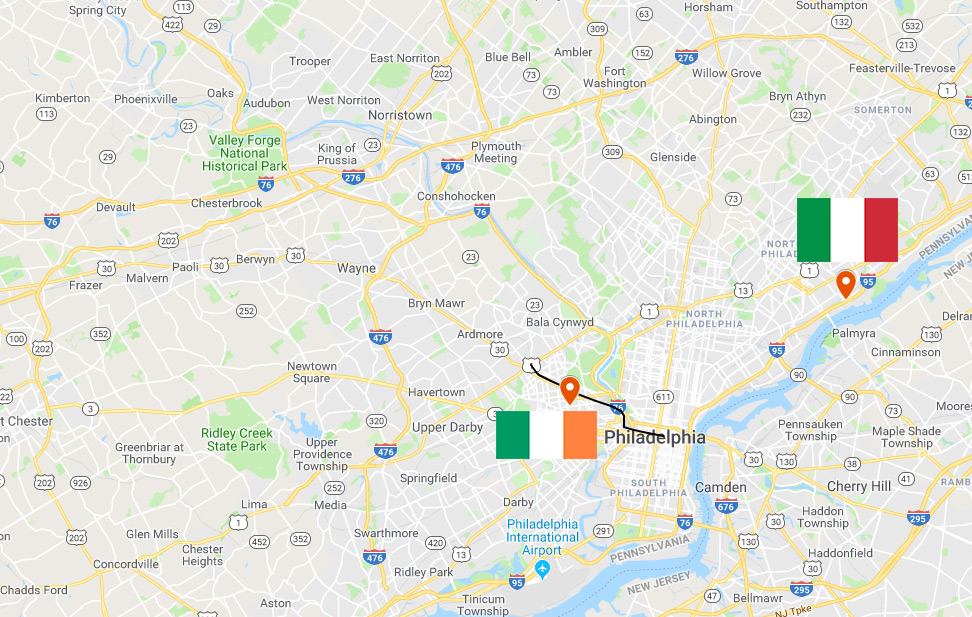
My Irish family and my wife’s Italian family lived in the same town at the same time.
This was, by far, the happiest surprise of all. My grandmother was born and raised in the Tacony neighborhood of Philadelphia. My wife’s grandfather, coincidentally, was also born and raised in the Tacony neighborhood of Philadelphia. In fact, the houses they grew up in were less than 11 miles apart from each other and I was able to confirm they lived there at the exact same time.
I had no idea that this could have been the case, and it makes my heart glad to know that the Irish immigrant side of my own family lived across the tracks—literally, across the trolley tracks—from the Italian immigrant family my wife came from. Can you imagine a more American story than that? Visiting Philadelphia and driving around in a rental car past the childhood homes of both these families was sobering and exciting. In addition, who knew that these two families could be so close for so many years (at least 10) and yet disperse to different states down through the generations and then come together again in marriage? Amazing. And to think, I only added in a trip to find the Menditto family because I was going to be in the area already anyway.
On the image below, the left pin shows the McElwee home and the right pin shows the Menditto home.